.png)
The Minimum Viable Product approach was supposed to be the antidote to building products nobody wants. Launch fast, learn quickly, iterate based on real feedback. Simple in theory. Devastatingly difficult in practice.
The irony? MVPs are designed to be minimal, yet most teams end up building something far larger, more expensive, and more time-consuming than necessary. They set out to validate an idea and end up with a bloated product that's neither minimum nor viable.
This article examines the most common MVP software development challenges—from feature creep to budget overruns—and provides actionable strategies to overcome them. Whether you're a first-time founder or a seasoned product manager, understanding these pitfalls could be the difference between a successful launch and joining the 90%.
Why MVP Development Is Critical—And Why It Often Goes Wrong
The purpose of an MVP is elegantly simple: validate your core assumptions with minimal investment. Instead of spending eighteen months and half a million pounds building a fully-featured product, you build just enough to test whether anyone actually wants what you're offering.
Done correctly, an MVP helps you:
- Reduce risk by testing demand before heavy investment
- Conserve resources by avoiding unnecessary features
- Accelerate learning through real user feedback
- Attract investors with validated traction
Yet despite these clear benefits, MVP development frequently goes sideways. Teams that understand the concept intellectually struggle to execute it practically. The result is projects that take three times longer than planned, cost twice the budget, and still fail to validate the core hypothesis.
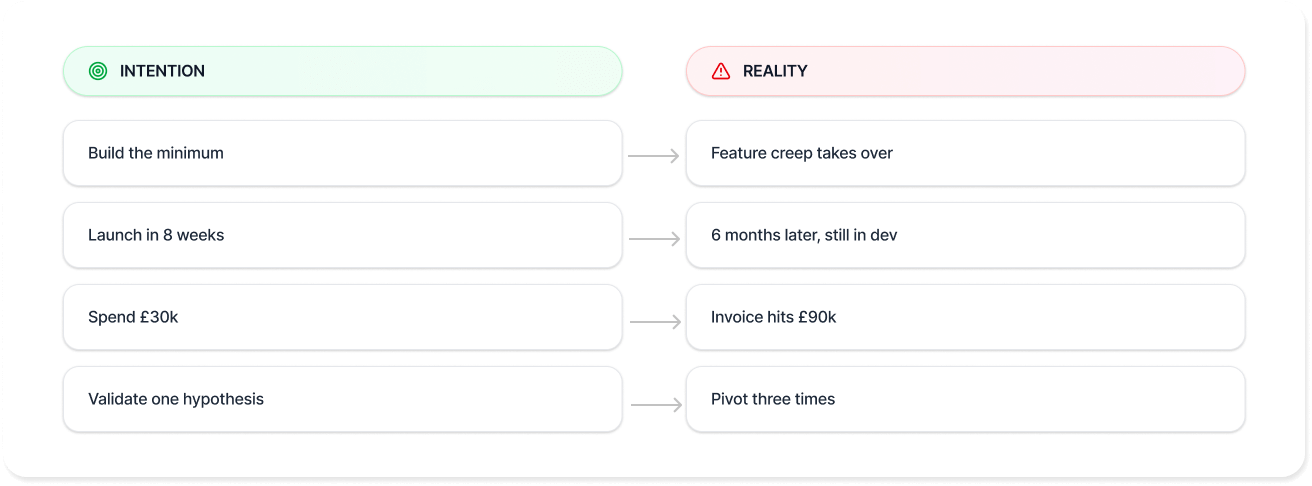
Why does this happen? Because MVP development challenges aren't primarily technical—they're psychological, organisational, and strategic. Understanding what goes wrong is the first step to getting it right.
The Real Disadvantages of MVP Development
Before diving into specific challenges, it's worth acknowledging that the MVP approach itself has inherent limitations. Recognising these helps you plan accordingly.
Risk of Negative First Impressions
When you launch a stripped-down product, you risk users judging your vision by its earliest, roughest execution. First impressions matter enormously in crowded markets. A clunky MVP might turn away the very early adopters you need most.
The key is understanding the difference between "minimum" and "broken." Your MVP should be incomplete, not incompetent. Core functionality must work flawlessly, even if peripheral features are absent.
Misinterpreted Feedback
Users might reject your MVP for reasons unrelated to your core value proposition. Perhaps the onboarding was confusing, or the design felt untrustworthy, or a critical bug obscured the benefit. Separating signal from noise in early feedback requires discipline and humility.
Always ask: Are users rejecting the concept or the execution?
Technical Debt Accumulation
Shortcuts taken during MVP development have a way of haunting you later. That "temporary" database structure becomes permanent. That "quick fix" authentication system becomes a security liability. Technical debt compounds with interest.
The challenge is knowing which shortcuts are acceptable (you might pivot anyway) and which will cripple you (core architecture decisions).
Scope Ambiguity
What's "minimum" for one team is bloated for another. Without crystal-clear success criteria, MVPs expand to fill available time and budget. This ambiguity is perhaps the root cause of most MVP failures.
The 5 Biggest MVP Development Challenges
Based on patterns observed across hundreds of startup projects, five challenges consistently derail MVP development. Each is predictable, and each is preventable.
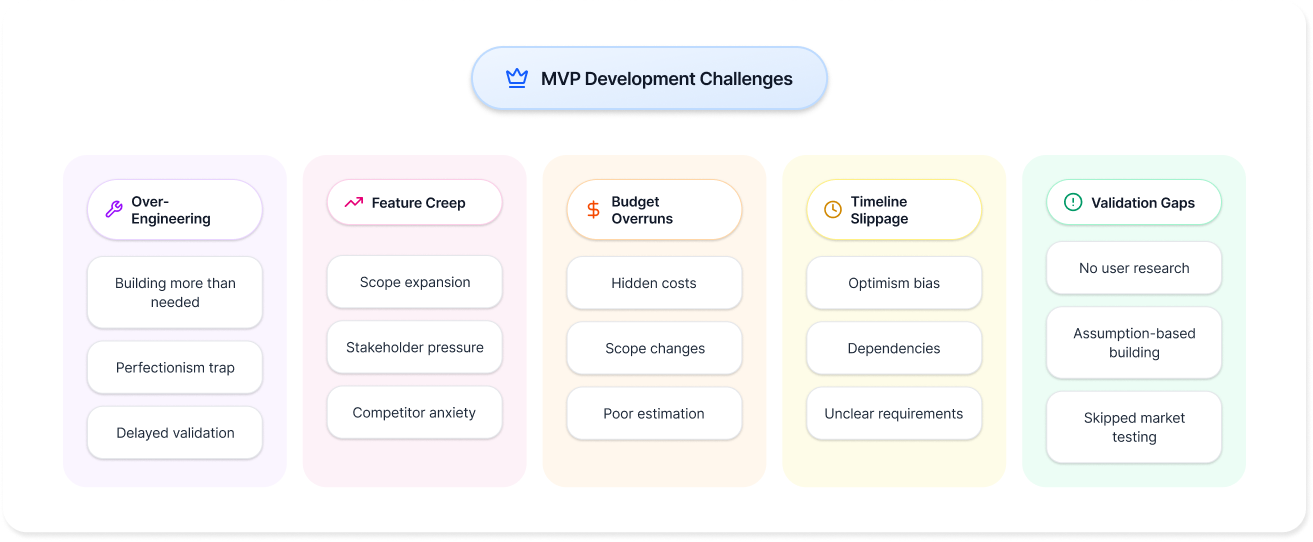
Over-Engineering: Building More Than You Need
Over-engineering is the tendency to build solutions that are more complex, robust, or scalable than the current situation requires. In MVP development, it's the kiss of death.
Why it happens:
Developers are trained to build things "properly." They think about edge cases, scalability, maintainability, and best practices. These instincts serve them well in mature products but actively harm MVP efforts. The fear of technical debt and the desire for elegant code can lead teams to spend weeks perfecting systems that might be discarded after user feedback.
What it looks like:
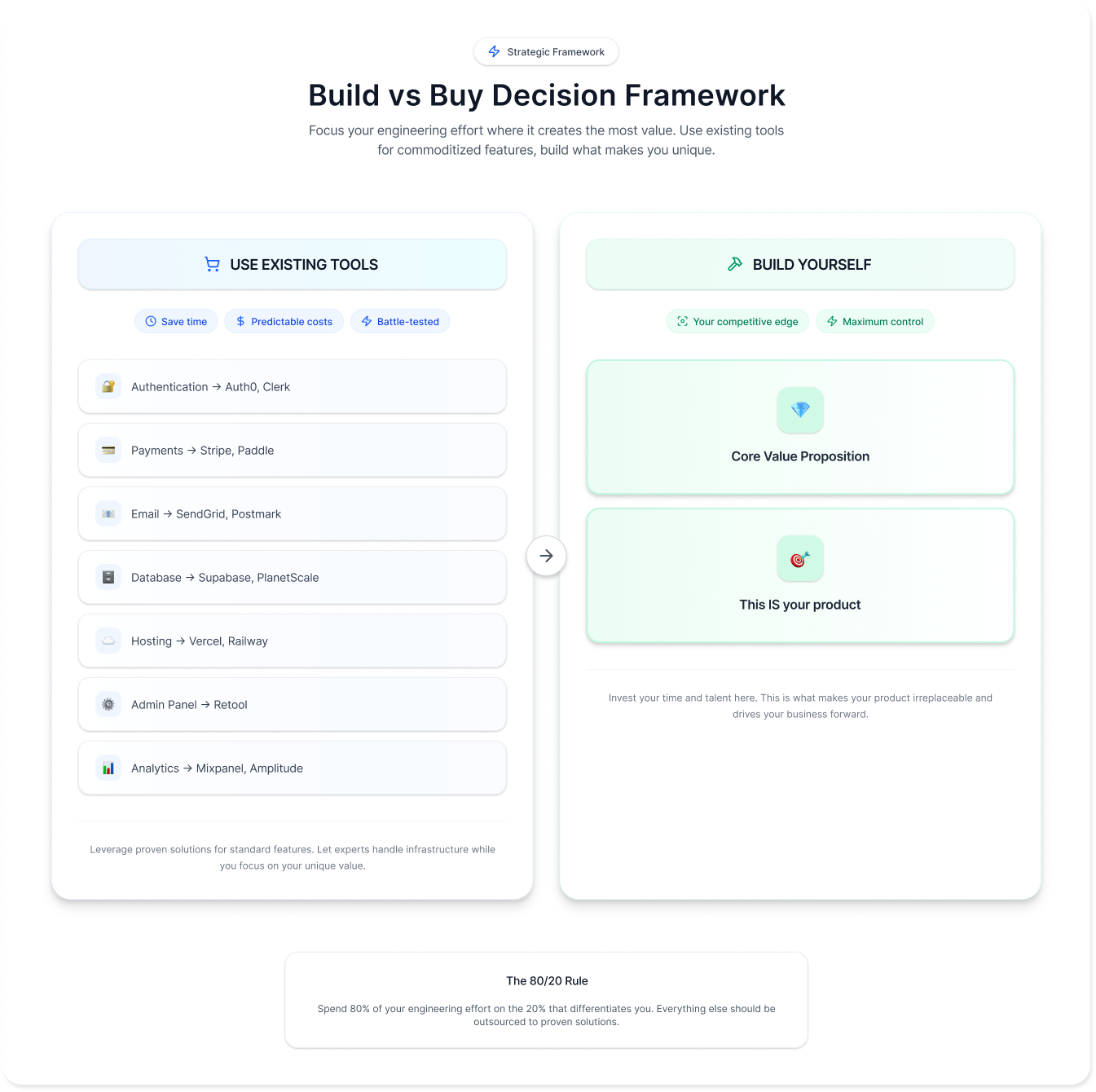
- Building a custom authentication system instead of using Auth0 or Firebase
- Designing a database schema for millions of users when you have none
- Creating an admin dashboard before you have anything to administrate
- Implementing microservices architecture for a product with three features
The real cost:
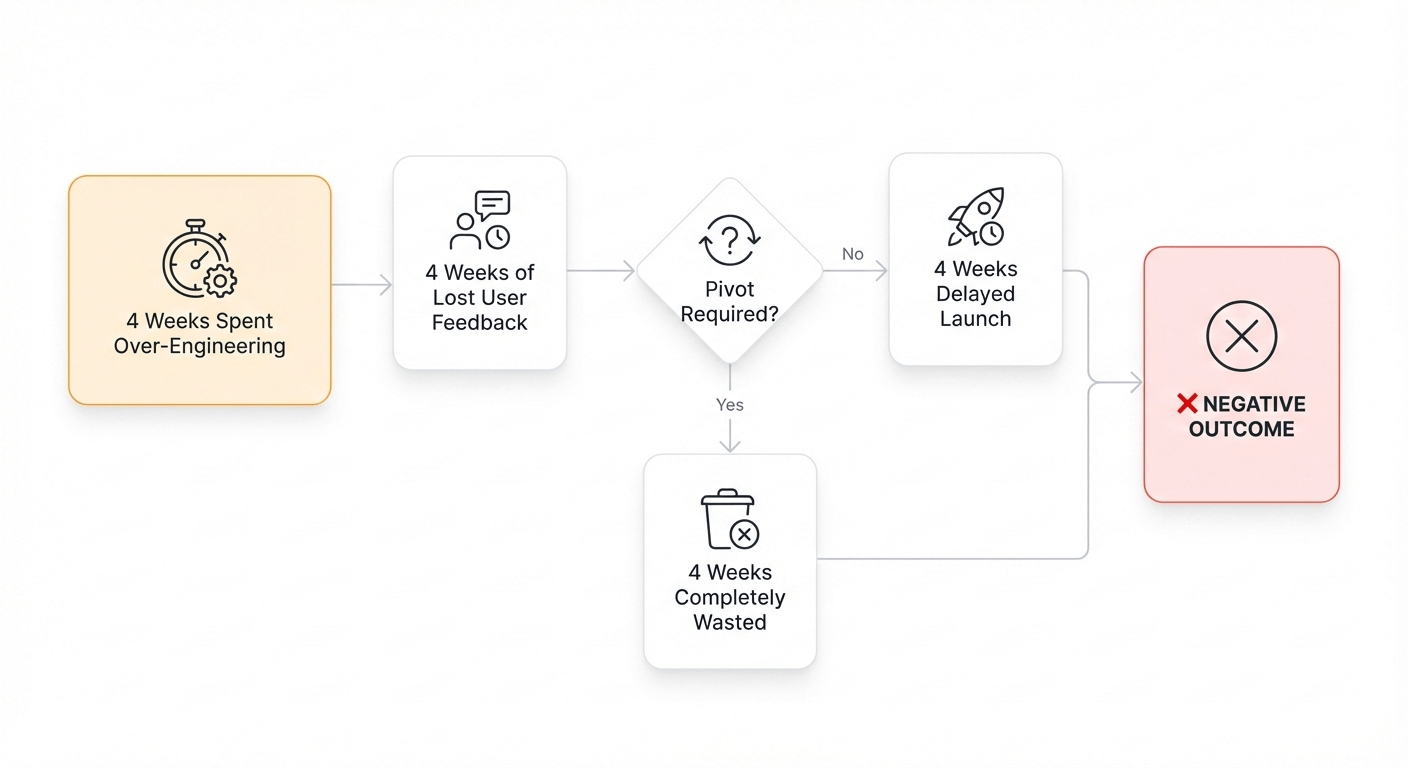
Over-engineering doesn't just waste time—it delays validation. Every week spent perfecting infrastructure is a week not spent learning whether users want your product. And if they don't? All that "proper" engineering was pointless.
Feature Creep: The Silent MVP Killer
Feature creep is the gradual, often imperceptible expansion of project scope beyond original intentions. It's "silent" because each individual addition seems reasonable, even necessary. Only in aggregate does the damage become apparent.
Why it happens:
- Stakeholder pressure: Investors, advisors, and team members all have opinions about what the MVP "needs."
- Competitor anxiety: You see a rival launch a feature and panic about being left behind.
- "Just one more" syndrome: Each feature request seems small in isolation.
- Unclear ownership: Without a single decision-maker, scope expands by committee.
Warning signs your MVP is suffering from feature creep:
- Your backlog keeps growing faster than you can build
- The launch date has been pushed back more than twice
- Team members disagree on what "MVP" actually means
- You're building features "users might want" rather than features they've requested
- The product feels increasingly difficult to explain in one sentence
The relationship between feature creep and failure:
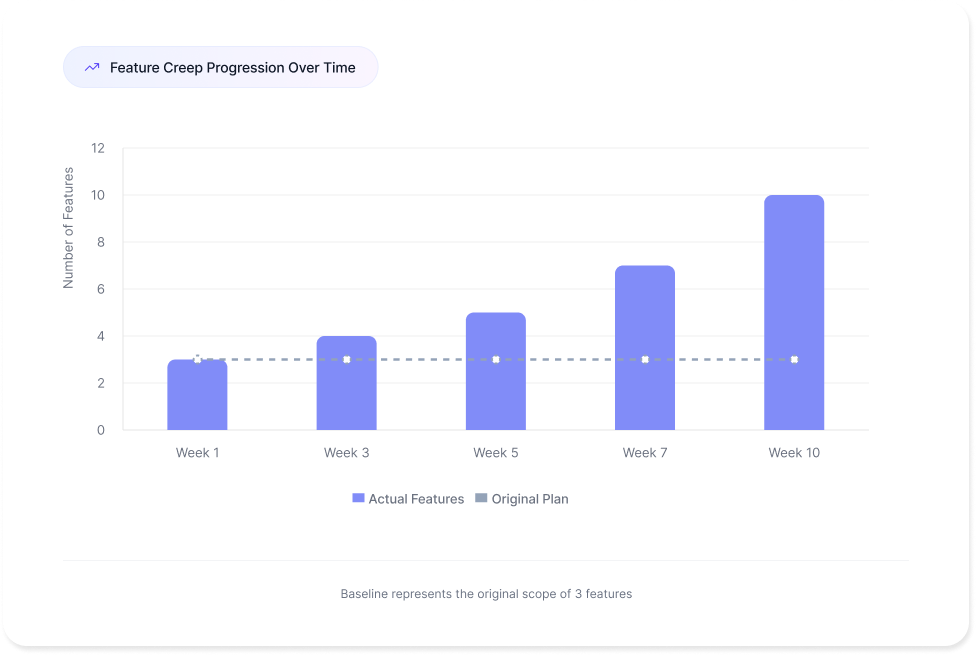
Original scope: 3 features in 8 weeks
Final scope: 10 features in 16+ weeks
Result: 3x scope, 2x timeline, 2.5x budget
Budget Overruns: Why MVPs Cost More Than Expected
"Why is MVP development so expensive?" is one of the most common questions founders ask. The answer lies in understanding what causes budget overruns—and recognising that the quoted price is rarely the final price.
What is a budget overrun?
A budget overrun occurs when actual costs exceed planned costs. In software development, overruns of 50-100% are disturbingly common. For MVPs specifically, the combination of uncertainty and scope changes creates perfect conditions for financial surprises.
Common causes:
CauseDescriptionTypical ImpactScope changesFeatures added mid-development+30-50%Poor estimationUnderestimating complexity+20-40%Hidden costsInfrastructure, tools, licenses+10-20%Integration issuesThird-party APIs behaving unexpectedly+10-30%ReworkChanging requirements causing rebuilds+20-50%
What should an MVP actually cost?
Costs vary dramatically based on complexity, but here are rough benchmarks for 2026:
.png)
The relationship between feature creep and budget overrun is direct and predictable. Every feature added increases cost not just by its own development time, but through increased integration complexity, testing requirements, and maintenance burden.
Timeline Slippage: When "8 Weeks" Becomes 6 Months
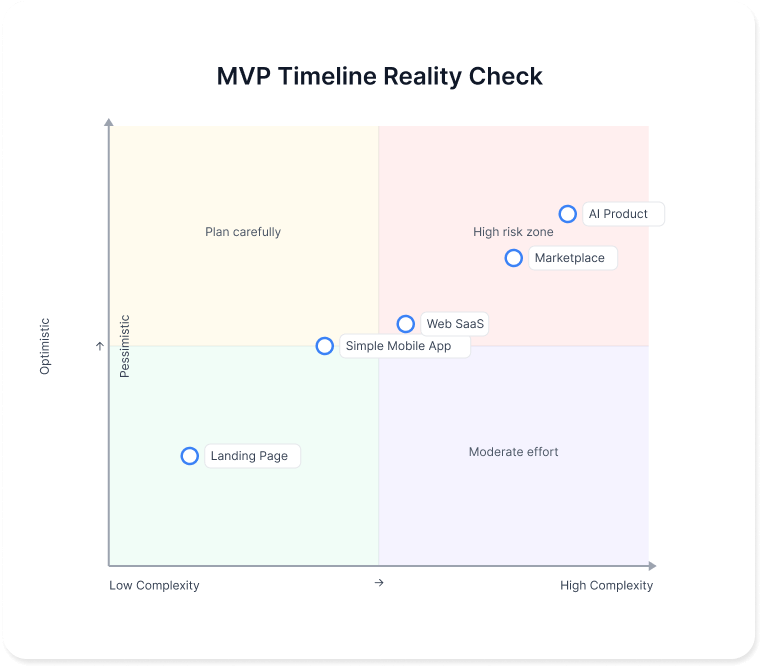
Few things are more frustrating than watching a deadline slip repeatedly. You planned for eight weeks, but week eight arrives and you're perhaps halfway done. The new estimate is twelve weeks. Then sixteen. Then "we'll see."
Why timelines slip:
- Optimism bias: Developers (and founders) consistently underestimate how long things take
- Dependency chains: One delayed component blocks everything downstream
- Unclear requirements: Ambiguity requires clarification rounds that consume time
- Context switching: Team members juggling multiple projects lose efficiency
- Testing debt: Insufficient testing early means bug-fixing marathons later
Realistic MVP timelines by project type:
The hidden cost of delays:
Timeline slippage isn't just an inconvenience—it carries real costs:
- Missed market windows: Seasonal opportunities or industry events
- Competitor advantage: Others may launch first
- Team morale: Repeated delays demoralise the team
- Investor confidence: Delays signal execution problems
- Cash runway: Every extra month burns precious capital
Validation Gaps: Building Without Confirming Demand
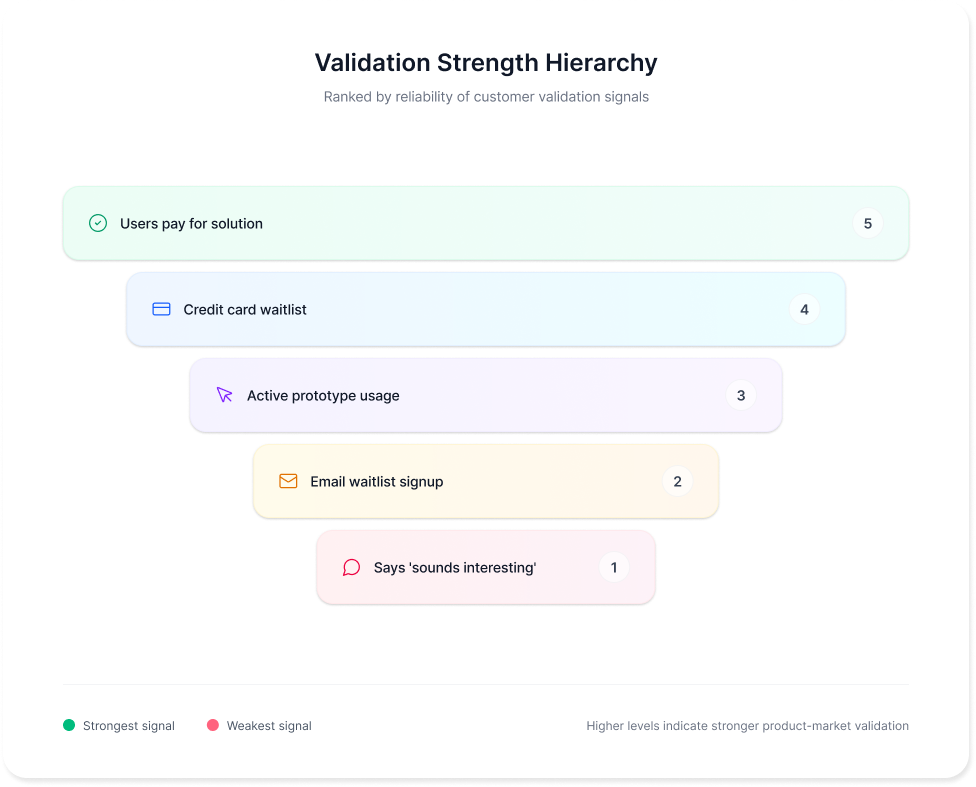
Perhaps the most fundamental MVP challenge is building without adequate validation. Teams become so focused on the "product" part of MVP that they forget the "viable" part requires actual market demand.
The danger of skipping validation:
You can build the most elegant, well-engineered MVP in history—and still fail completely if nobody wants it. Validation isn't a phase you complete before development; it's an ongoing process that should inform every decision.
Signs of validation gaps:
- You can't name ten people who are desperate for your solution
- Your user research consists of asking friends if your idea "sounds good"
- You've never watched a potential user try to solve the problem you're addressing
- Your feature priorities are based on assumptions, not user input
- You're building for a market you've never worked in or deeply studied
The validation hierarchy:
How to Overcome MVP Development Challenges: Proven Strategies
Understanding challenges is valuable. Overcoming them is essential. The following strategies have been proven effective across diverse industries and project types.
Start With Clear Success Criteria
Before writing a single line of code, define what success looks like. This isn't about feature lists—it's about outcomes.
The "One Metric That Matters" approach:
Choose a single primary metric that will determine whether your MVP succeeded. Everything else is secondary. This focus prevents scope creep by providing a clear filter: does this feature directly impact our primary metric?
Examples of MVP success criteria:
Product TypePrimary MetricTargetB2B SaaSPaying customers10 customers at £100/monthConsumer appDaily active users500 DAUs after 30 daysMarketplaceCompleted transactions50 transactions in first monthContent platformSubscriber conversion5% of visitors subscribe
Document your success criteria before development begins. Share it with your entire team. Reference it whenever someone suggests a new feature.
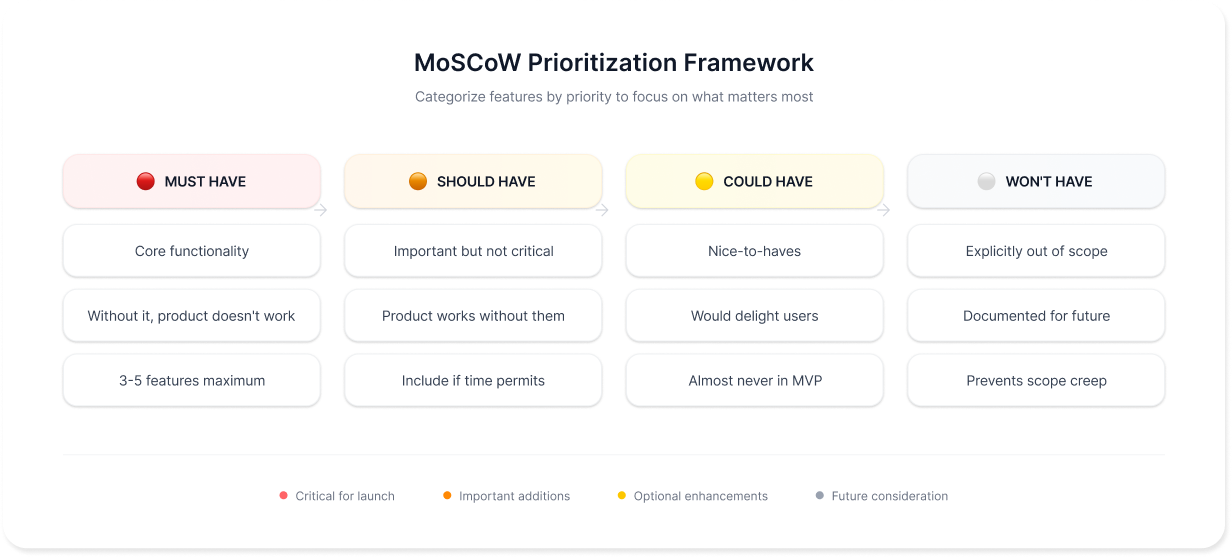
Ruthless Feature Prioritisation
Not all features are created equal. Ruthless prioritisation separates successful MVPs from bloated failures.
The MoSCoW Framework:
The "Must-Have" Test:
For each proposed feature, ask: "Would users refuse to pay or refuse to use the product without this?" If the answer is no, it's not a must-have.
How to say no diplomatically:
When stakeholders request features, don't dismiss them. Instead:
- Acknowledge the value of their suggestion
- Explain how it relates to the primary success metric
- Add it to the "post-MVP" roadmap visibly
- Refocus on what's shipping now
Time-Box Development Ruthlessly
Fixed deadlines force difficult decisions. Without them, projects expand indefinitely.
The "Fixed Time, Flexible Scope" approach:
Traditional project management fixes scope and lets time flex. MVP development should do the opposite. Set an immovable launch date and adjust scope to meet it.
How to implement:
- Set a launch date 8-12 weeks out (maximum)
- Work backwards to create weekly milestones
- Review progress weekly against milestones
- If behind schedule, cut features—never extend timeline
- Launch on the date regardless (with whatever is ready)
Why constraints breed creativity:
When you can't add time, you find smarter solutions. You use existing tools instead of building custom ones. You simplify flows instead of adding complexity. You focus on what matters instead of what's interesting.
Build Fast, Learn Faster
Speed isn't just about efficiency—it's about learning. The faster you ship, the faster you learn, the faster you can improve or pivot.
Embrace imperfection:
Your MVP will have bugs. Your design won't be pixel-perfect. Some edge cases won't be handled. This is acceptable—even desirable. Perfection is the enemy of learning.
Use existing tools aggressively:
Parallelize validation and development:
Don't wait until the product is built to start validating. Run user interviews while development is underway. Build a landing page before the product exists. Collect email addresses and gauge interest in real-time.
Choose the Right Development Partner
For many startups, the choice of development partner determines success or failure. The wrong partner amplifies every challenge discussed in this article. The right partner helps you avoid them entirely.
In-house vs. outsourced:
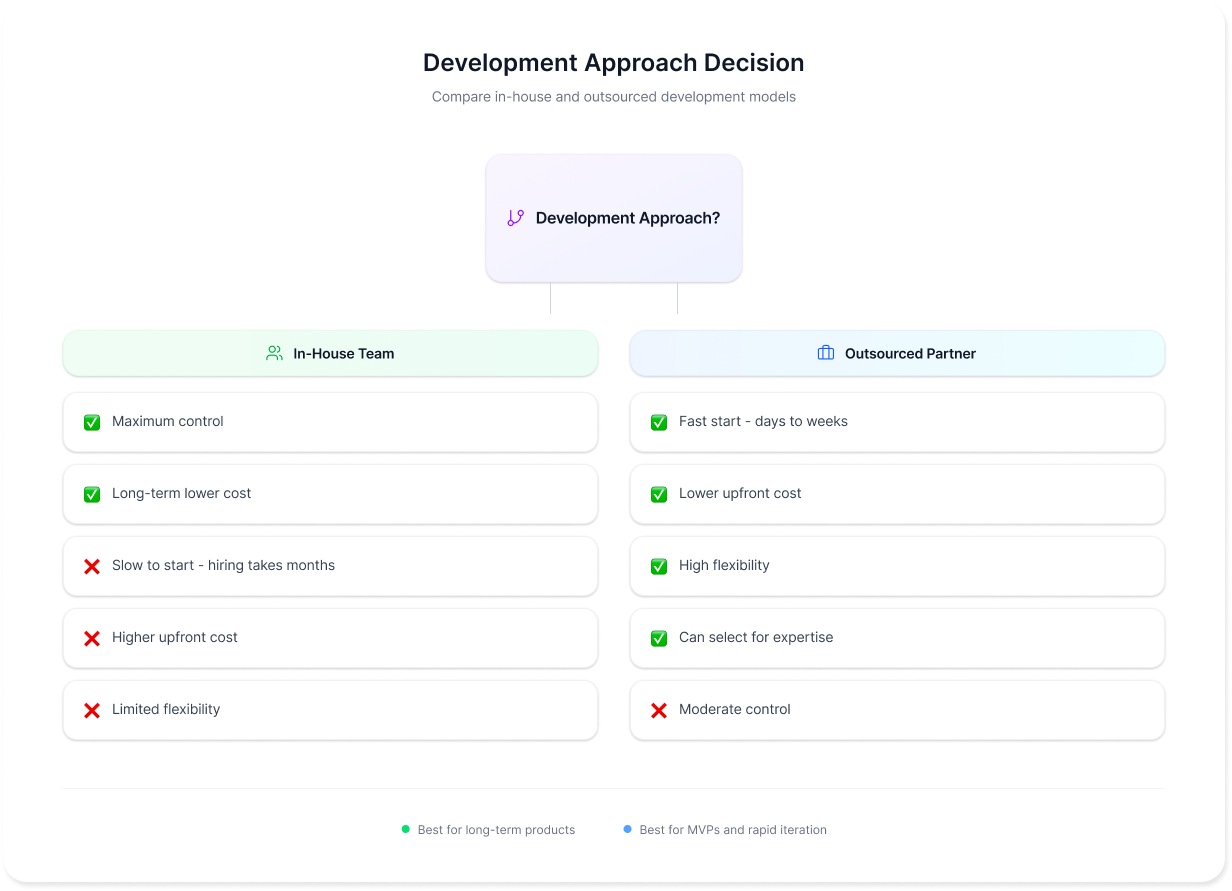
What to look for in an MVP development partner:
- Relevant experience: Have they built similar products before?
- MVP mindset: Do they understand that speed trumps perfection?
- Transparent communication: Weekly updates, clear progress tracking
- Flexible engagement: Can they adapt as requirements evolve?
- Post-launch support: What happens after the MVP ships?
Red flags to avoid:
- Partners who want to build everything from scratch
- Reluctance to use existing tools and services
- Vague timelines or "it depends" pricing
- No process for handling scope changes
- Past projects that took much longer than quoted
The right development partner acts as a collaborator, not just an executor. They challenge unnecessary complexity, suggest simpler alternatives, and keep the focus on validation rather than perfection.
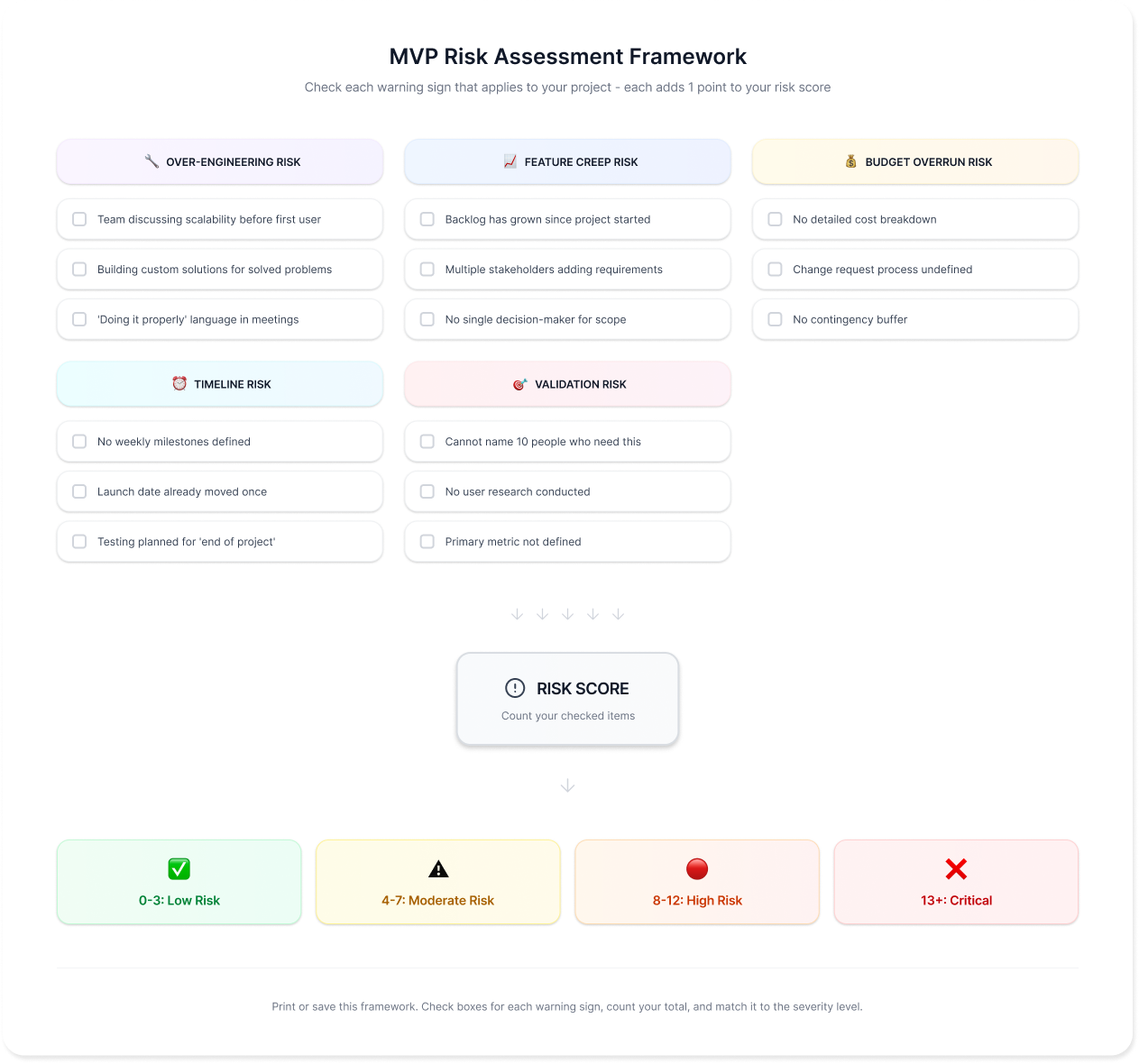
MVP Development Challenge Checklist: Assess Your Risk
Use this checklist to evaluate your current MVP approach. Each "yes" indicates a potential risk area requiring attention.
Build Smarter, Not Bigger
MVP development challenges are predictable. Over-engineering, feature creep, budget overruns, timeline slippage, and validation gaps appear in project after project, industry after industry. But predictable doesn't mean inevitable.
The teams that succeed share common traits:
- They define success before starting and use that definition to filter every decision
- They prioritise ruthlessly, saying no to good ideas to focus on essential ones
- They embrace constraints rather than fighting them
- They value learning over perfection and ship early to learn fast
- They choose partners wisely, selecting collaborators who share their MVP mindset
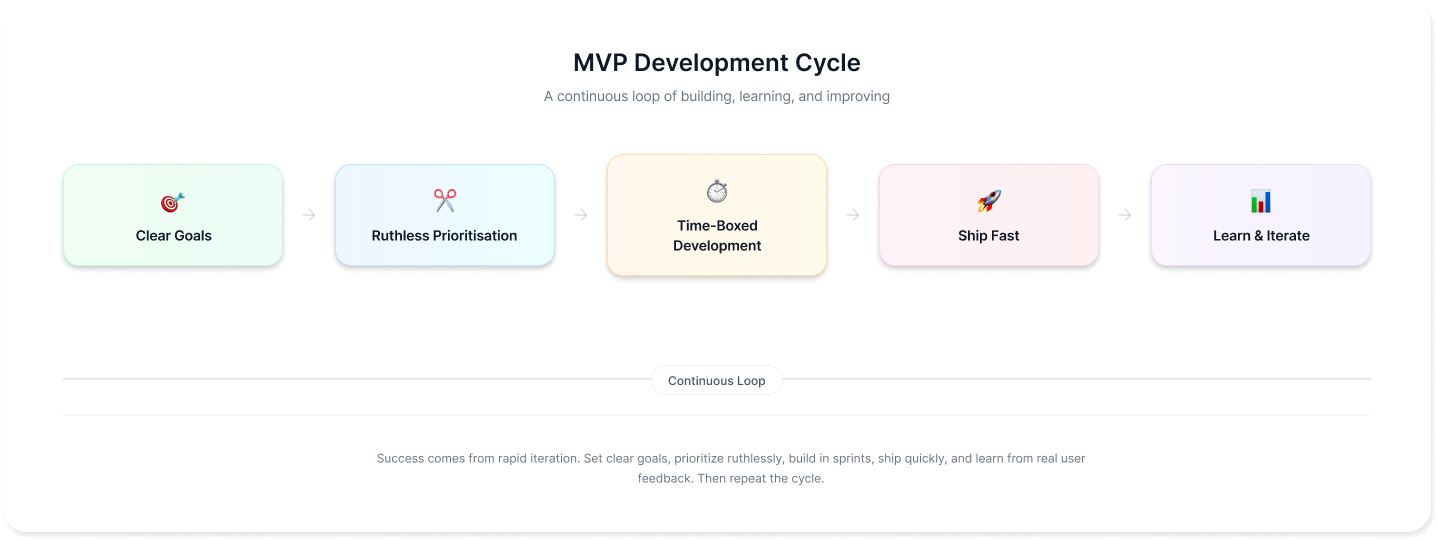
The goal of an MVP isn't to build a small product. It's to learn whether you should build the full product at all. Every feature, every week, every pound should serve that goal.
If your current MVP approach has you worried—if timelines are slipping, budgets are ballooning, or you're unsure whether you're building something people actually want—it might be time to step back and reassess.
The best MVPs aren't built by the biggest teams or the largest budgets. They're built by focused teams with clear goals, disciplined processes, and the wisdom to know what not to build.
Ready to build your MVP without the common pitfalls? Talk to PQ Impact's team →
Our dedicated teams specialise in helping startups navigate MVP challenges—from feature prioritisation to rapid validation. We've seen what works and what doesn't, and we bring that experience to every engagement.